Living inside a R.E.P.L
Ready Player 1
What if you could hack tech and design on your desktop, then resume that work from your phone anywhere in the world?
What if after finding a particularly good solution, you could not only record your work for posterity but also turn it into an elegant, reusable recorded work template?
What if you could resume hack mode on your desktop at exactly the points where you last left off across various projects?
What if you could operate your recorded work templates from anywhere, at any time, directly from your mobile device?
Introducing Zehen Telegram R.E.P.L. (ZTR)
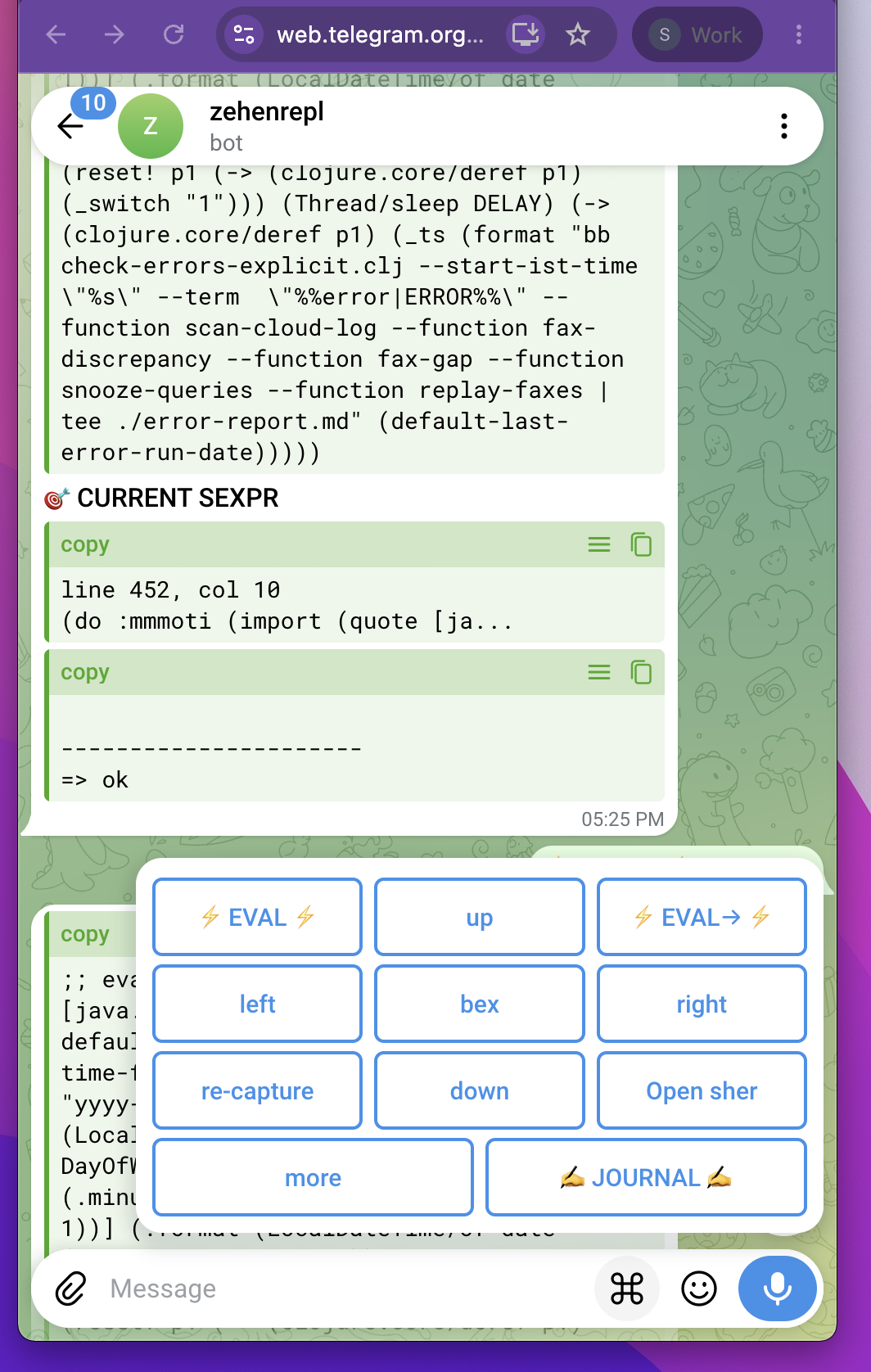
At its core, ZTR is a thin Telegram bot that acts as a client for a Babashka Clojure socket REPL. That makes it a true Lisp REPL in every sense of the word. It works with s-expressions.
From Telegram, I am not typing s-expressions 99% of the time. I am usually navigating through pre-written ones and hitting carefully designed UI buttons.
That shifts the problem from typing to navigation, and the bot's UI is built around that idea. It has rich navigation features that make it easy to move through existing workflows, trigger actions, and compose work from a mobile interface.
Trying to list all of its benefits would be like trying to list everything one can do with a computer with coding agents connected to the internet, so I will not even try. I also will not pretend this is for everyone. It can be extremely dangerous if you do not know what you are doing. But for elite-level engineers, it can provide enormous leverage. No AI inference or LLM tokens used at runtime. Zero hallucination. 100% deterministic.
ZTR lets me use my desktop as the main REPL client (it is technically an nREPL client connected to Vim) for building software with agents. Yes, at design time I need inference, but not at runtime or ZTR time. The same work is still available from anywhere in the world because the s-expressions are shared between all REPL clients.
A key reason this is even possible is my long-term investment in s-expressions as my primary way of representing and executing work. I was already working this way; the Telegram REPL simply made that work reachable from my phone. It feels like a huge dividend from an investment made over many years.
No SSH. Excellent offline support. Built-in search through Telegram. Dynamic buttons for different thinking and operational modes, inspired by products like the Elgato Stream Deck, but for my purposes, much more powerful.
It does not just let me store work. It also lets me summon custom sets of UI buttons on demand: one set for working on finances, another for preparing for a standup, another for journaling, and so on. Creating custom buttons is also straightforward and largely agent-driven.
There is another important update. Zehen was originally built around s-expressions that relied on tmux for side effects. Zehen now has native support for making all of its s-expressions, and much more importantly, my muscle memory that I had accumulated over more than five years, work on Herdr as well. To me, this is a testament to how future-proof Zehen's architecture is. By relying on simple protocols and focusing on workflows and organization, Zehen can absorb future changes quickly and easily.
I have been using the Telegram REPL bot for more than a month now, especially for journaling. It has replaced the web app telecontroller I was using before, and it has made a large part of my working system available from my phone.
- [x] Made a Lisp REPL
- [x] Live inside it
- [ ] Reify life's single-player game interface. Ready Player 1! Leveling up!!